Tiny Penthouses 02 - Amsterdam, Stedelijk


TINY PENTHOUSES 02, 2024-2025
In the 1920s, Le Corbusier envisioned Plan Voisin for Paris, aiming to replace a significant portion of central Paris with high-rises to drastically improve living conditions. A century later, a comparably radical plan emerges for Amsterdam. Unlike the demolition-focused approach of the past, this plan builds atop the existing urban fabric, introducing a fleet of Tiny Penthouses.
By embracing the plan, the Stedelijk museum could acknowledge its own public role and societal responsibility, igniting discussions on the Dutch housing crisis. Since how can art flourish without available homes for art students in the city? In doing so, it sets a precedent for other public institutions, inspiring them to take proactive steps.
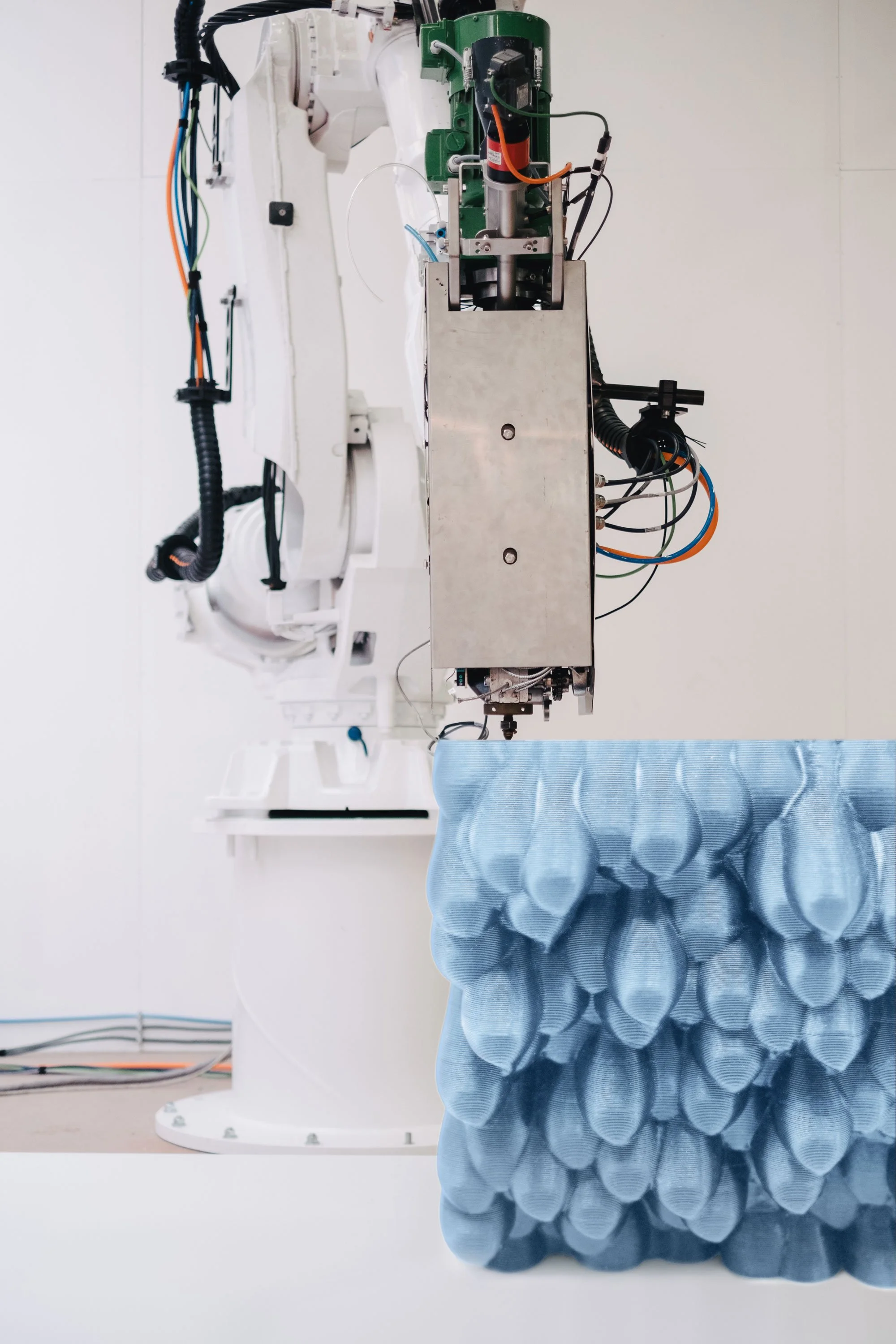
The Tiny Penthouses honor both the historic Stedelijk building by architect Adriaan Willem Weissman and the modern addition by Benthem Crouwel. Embracing a familiar silhouette, the homes seamlessly engage with the existing roof lights. Uniform in design for optimal building efficiency, each Tiny Penthouse is centered around a core housing a compact bathroom and kitchen. The bulbous facade, resembling oversized grapes, has a unifying character, yet upon closer inspection, reveals a unique design for each grape, just like the uniqueness of its inhabitants.
Despite their modest 50 m2 footprint, the central configuration of the Tiny Penthouses allows for very diverse floorplans, making them versatile spaces for work, exhibitions, or accommodating two students. A mezzanine, complete with an optional roof light, crowns the core, serving as a flexible area for a bedroom or additional storage. Strategically positioned wide north-facing windows bathe the interiors in ideal light for artistic pursuits, while the more enclosed south-facing façade provides ample shade during the summertime heat on the rooftop.
The Tiny Penthouses are designed with a material lifecycle in mind, and can reincarnate after use into newer, smarter structures that adapt to changing demands.
The public swiftly would embrace the row of houses, endearingly labeling it ‘the Kitkat.’
